Experience the Castle’s History
Entry tickets
You can purchase entry tickets at the museum’s reception upon arrival.
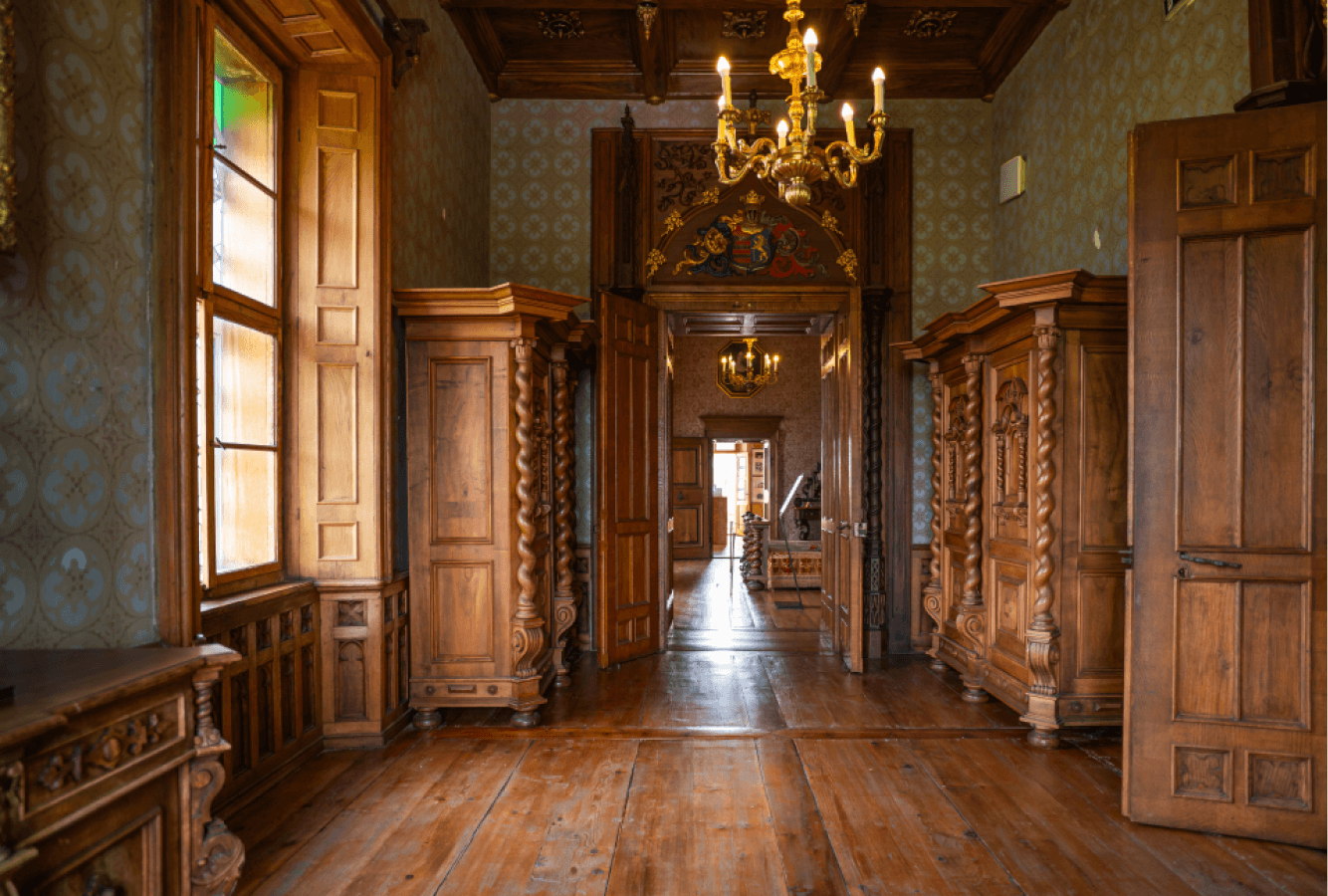
Ticket pricesAfter the castle’s extensive renovation in the 19th century, this became the best-furnished and most comfortable part, serving as the owner’s residence. It is largely furnished with items from the second half of the 19th century, as well as valuable heaters. Above the door are the lavishly carved coats of arms of the families to whom the Draškovićs were connected by marriage.
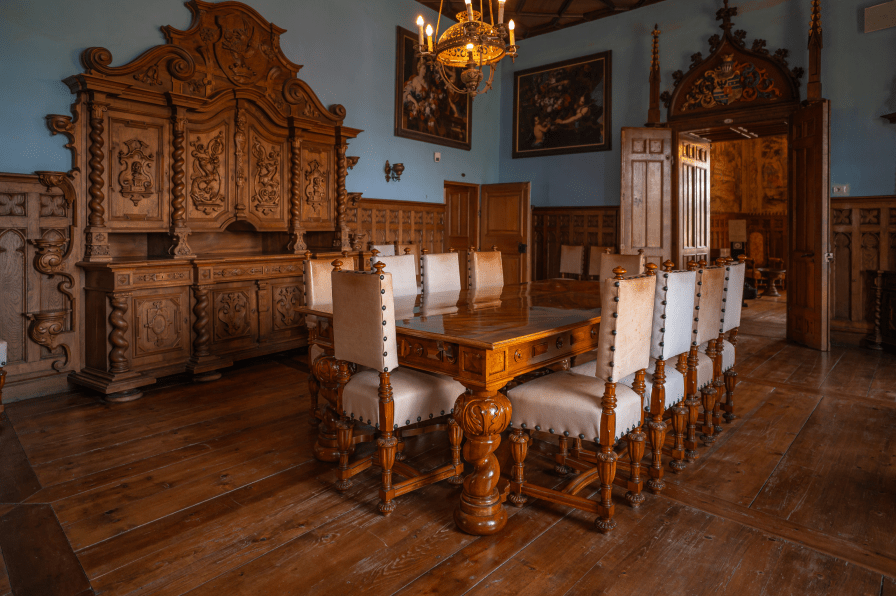
The dining room is furnished with neo-style furniture crafted in the 1860s, according to the owners’ strictly defined order, and whose coats of arms are on the items. The furniture consists of a large built-in cupboard, corner display cabinets, leather-upholstered chairs and a washstand table. Some of the preserved porcelain dishes from the 18th and 19th centuries are on display. The food was prepared in the castle’s kitchen located two floors below and was brought in from an ancillary room whose door is integrated into the wall panelling.
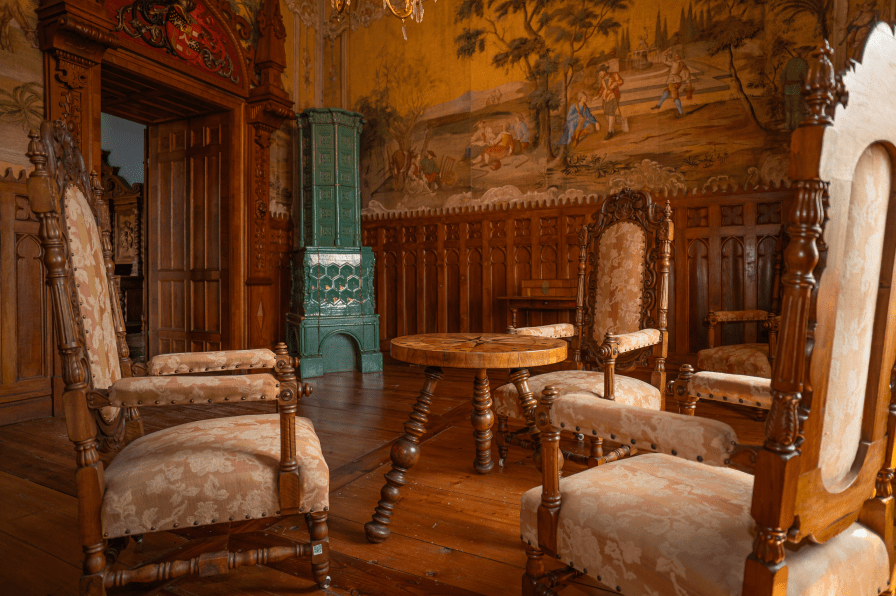
Located next to the dining room, on the southern, protruding main part of the building. It is laid out as a salon for relaxation and entertainment after meals. This is the only space in the castle where smoking was permitted. The painted wall decorations depict the idyll of 18th-century country life, modelled after the French tapestries of the time. The furniture has Neo-Baroque characteristics and also includes a gambling table. There is also a brazier, a heating vessel of oriental origin.
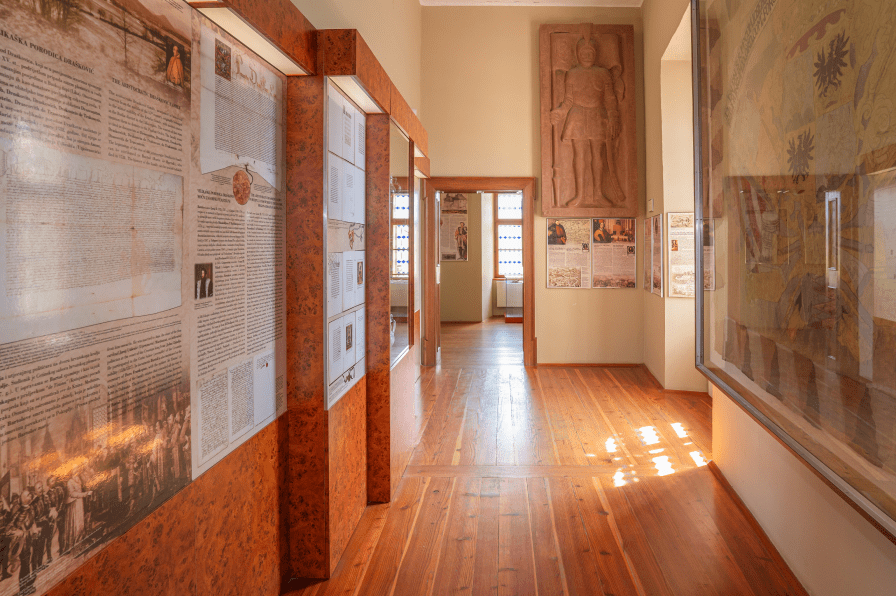
These two rooms, which briefly present the history of the Drašković family and Trakošćan Castle, are not arranged as ambient spaces, unlike most other rooms. The focus is on display panels featuring historical documents (such as deeds of donation and grants of arms) and concise descriptions of the estate’s history and the most important members of the family. Among the original museum artefacts exhibited here are four historical flags from the Drašković legacy and portraits of General Josip Kazimir Drašković’s officers.
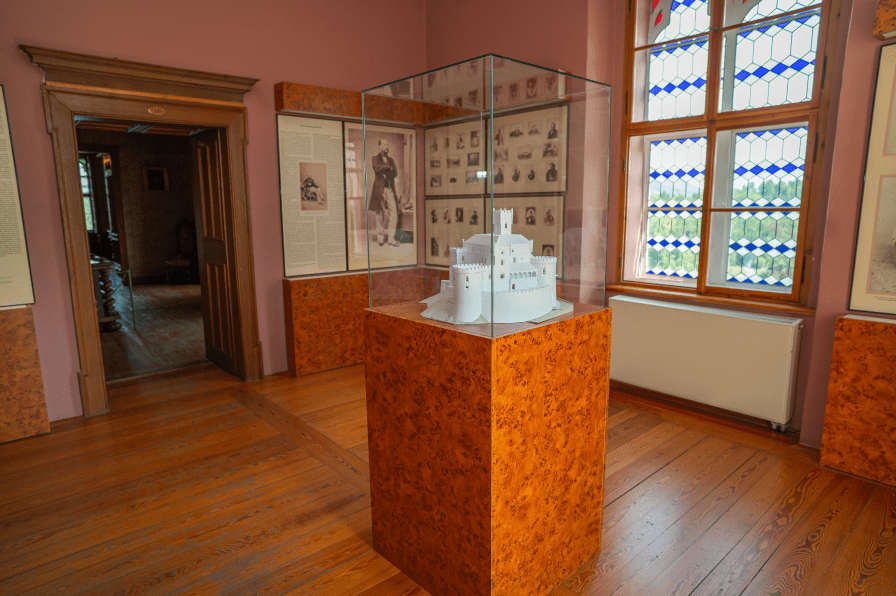
This room exhibits the photographic works by two members of the Drašković family, Juraj VI and his nephew Karlo Drašković, both of whom can be considered pioneers of photography in Croatia. Juraj VI Drašković is the first known amateur photographer in Croatia. His most common themes were portraits of individuals and group portraits of family members and friends. In 1865, he also produced what is currently the first known photographic nude in Croatian photography – Jurimir’s Young Lady. Karlo Drašković is considered one of the founders of artistic photography in Croatia and the most important Croatian amateur photographer of the 19th century. He achieved superb artistic and technical excellence in photography, leading to his acceptance into one of Europe’s most elite photography clubs, the Vienna Camera Club. He photographed landscapes, village people, folk costumes and architecture. From his extensive body of work, particular mention should be made of his stopped-motion photographs, such as Stjepan Erdödy’s Jump and L. Odeschalchi’s Dive into Water.
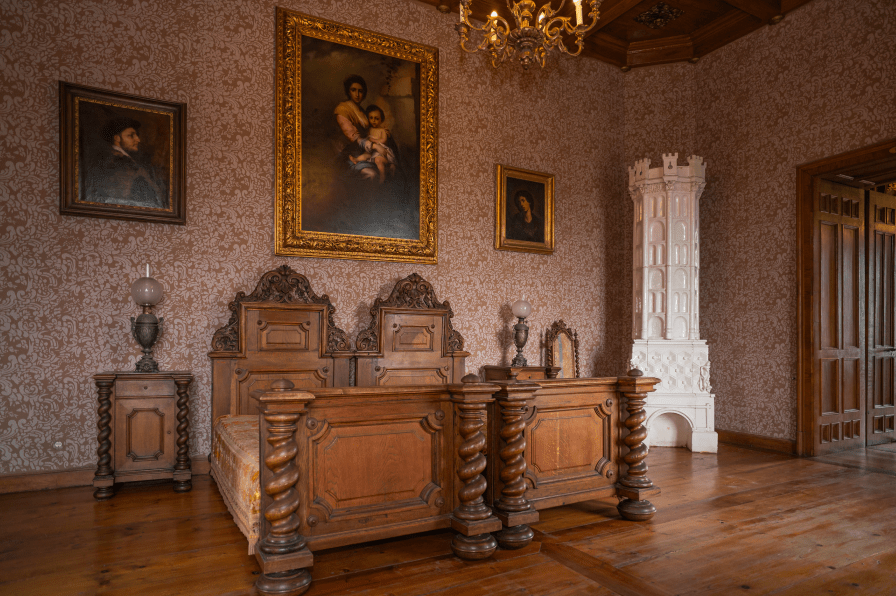
The castle owner’s bedroom is furnished in a unique Neo-Baroque style. The bedroom is particularly notable for its coffered ceiling and white tiled masonry heater in the shape of a tower. Interestingly, this is an almost completely faithful copy of a heater from Füssen Castle on the River Lech in Germany dating from 1514.
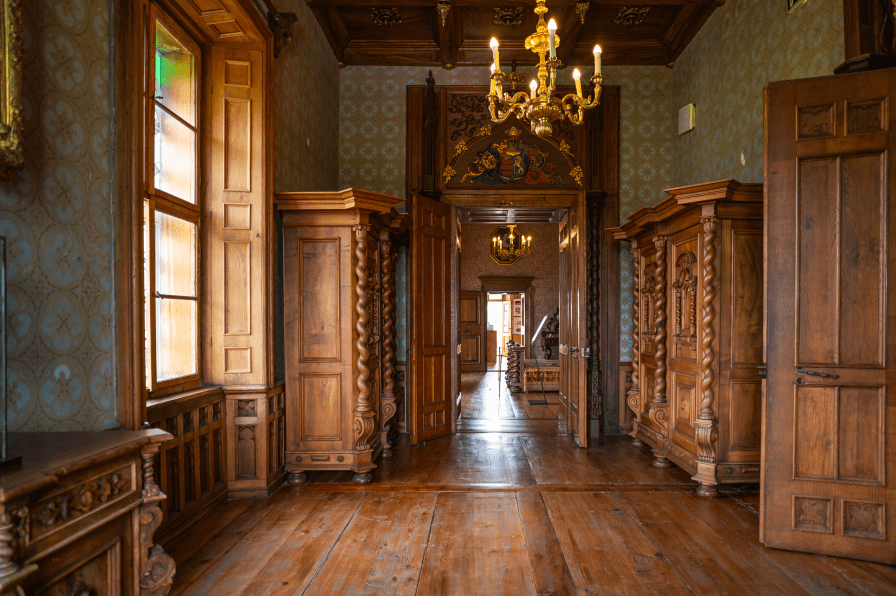
The antechamber is stylishly and functionally connected to the bedroom. Here are two large wardrobes, a cabinet and a standing mirror with the family coat of arms. On the wall is a portrait of Empress Maria Theresa, one of the most powerful and significant women in European history.
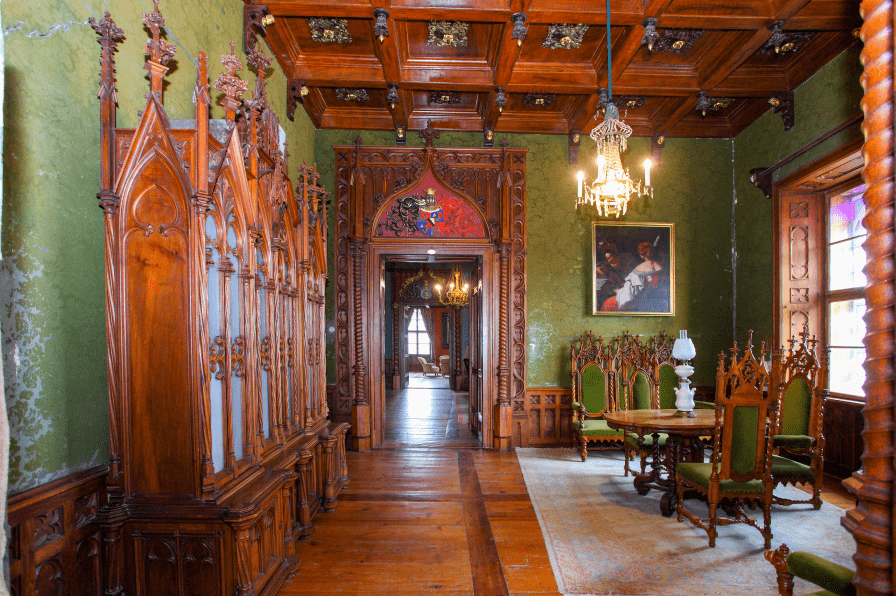
This small reading room is equipped with furniture, wall decorations and an open fireplace in the Neo-Gothic style. The preserved original plush wallpaper from the time of the previous renovation of the castle is colouristically in harmony with the rest of the drapery and clearly evokes the salon atmosphere of the second half of the 19th century. The furniture of distinct Neo-Gothic forms consists of a large cupboard that was used to store books, a three-seat sofa, chairs and armchairs.
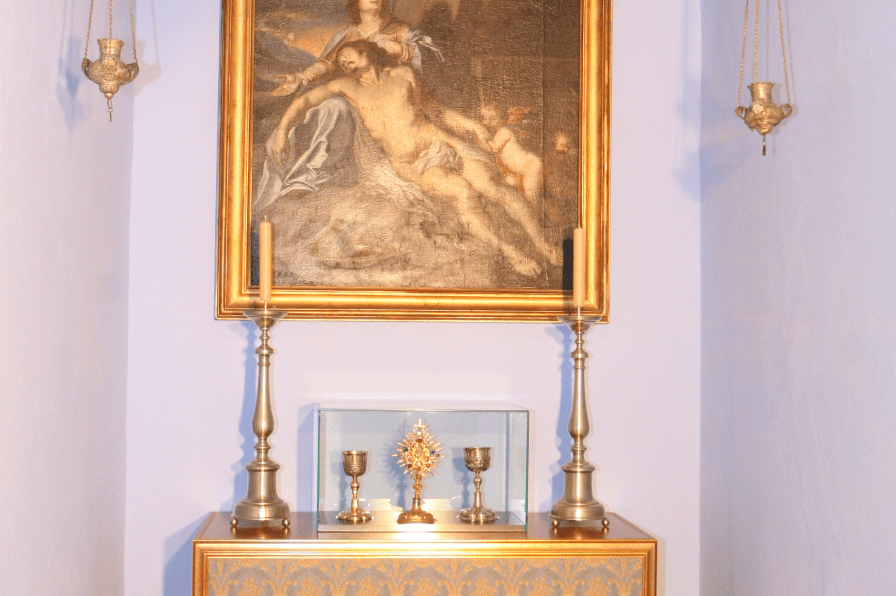
The reconstructed palace family chapel today houses part of the sacred material from the Drašković family legacy. In place of the altar that has not been preserved, a gilded monstrance decorated with precious stones and two chalices, also from the 18th century, are on show. On the walls are paintings of sacred themes, the central one being the Pieta, a work by an unknown painter from the 18th century. In addition to the paintings, there is a Baroque sacristy cupboard with richly carved panels. A special place is occupied by a well-preserved, richly illustrated and bound Bible from 1747.
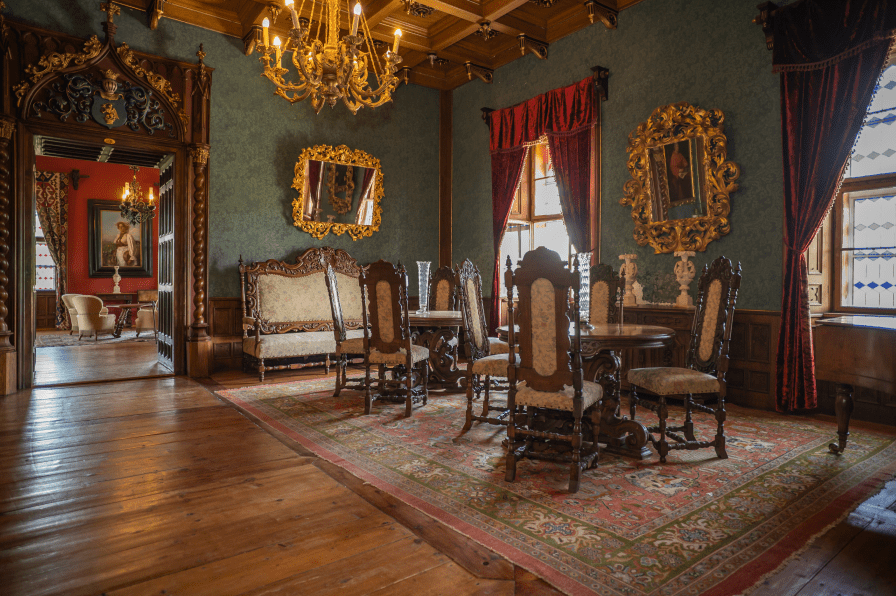
The music room is furnished more lavishly than the other rooms because it was the place where people spent most of their time. It has Neo-Baroque style furniture and is richly decorated with painted carvings and gilding. The tiled heater, made in the Rococo style, dates back to the 18th century and is the oldest in the castle. Portraits painted by Julijana Drašković, née Erdödy, are displayed on the walls of the room. Music was played here on an early form of piano with a wooden construction, made between 1833 and 1837 in the workshop of Conrad Graf, who was one of the most renowned Viennese piano builders of that era.
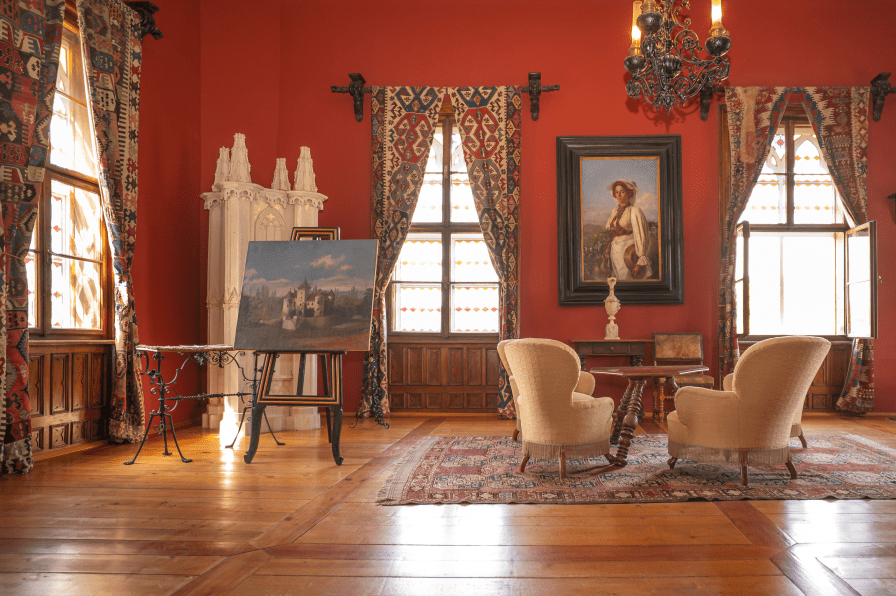
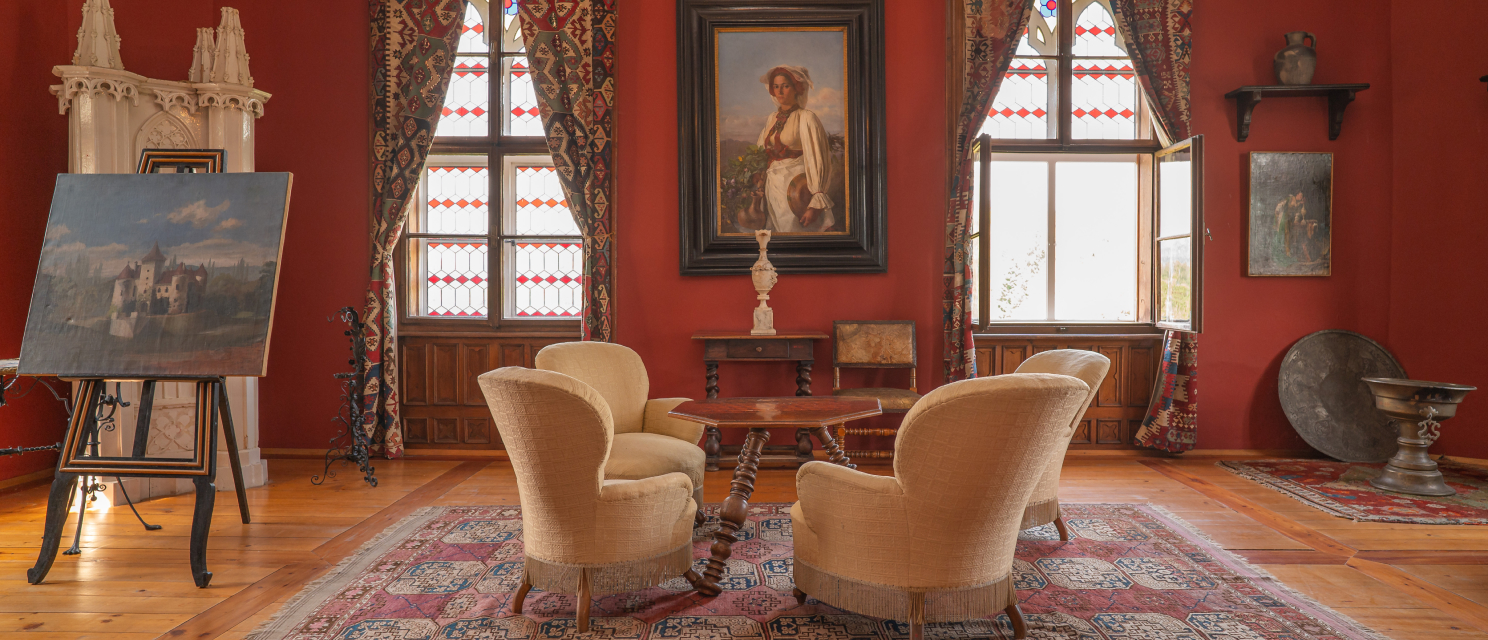
Julijana’s room is a reconstruction of the painting studio (atelier) of Countess Julijana Drašković, née Erdödy (1847-1901). Although she did not create a large opus of work, Julijana marked the beginning of Munich’s academic realism here. She was born in 1847 in Bratislava, in a branch of the Erdödy family that had estates in Bratislava and Novi Marof. Everything that surrounded her in her work and everyday life during her stay in Trakošćan is still in the studio with the painter’s easel, a table for paints and palettes, a piano and the paintings. A significant part of her opus is also here, and it is certainly worth highlighting the portraits of women in folk costumes from the Trakošćan area, the portrait of her husband Ivan IX, and a self-portrait at the piano. In addition to her paintings in the corner of the studio, there are also portraits of Julijana Drašković and her sister Valerie Erdödy, painted in the 1870s by Johann Till. Elements such as the window curtains, rug and brazier give the space an oriental spirit, which was very popular in the second half of the 19th century. The interesting neo-Gothic heater was heated by warm air flowing from a firebox in the room below.
Experience the Castle’s History
You can purchase entry tickets at the museum’s reception upon arrival.
Ticket prices